You prayed this morning. You meant it, too.
By evening you were up front at bible study, speaking with a confidence that made people lean in. Someone told you afterward that your words "hit different." You smiled and said all glory to God.
Then 11pm came.
Just tonight. Just this once. Then never again.
You've said that sentence to yourself more times than you can count. You don't even remember when it started anymore, it just feels like it's always been there, quietly, underneath everything else.
You turn the brightness down low. You tell yourself you're just tired, just stressed, just human. But some part of you knows this isn't really about being tired.
Some nights you Google it. How to stop porn addiction. 2am searches, deleted history, a strange kind of loneliness that no one in your life knows exists.
You think about the wedding. Five months away now. You think about standing at that altar and wonder — what am I bringing into this marriage that she doesn't know about?
You think about your church. The people who ask you for prayer. The ones who say "pastor, how do you stay so strong in the Lord?" And something in your chest tightens, because if they only knew.
You've fasted. You've prayed longer, harder, louder. You've thrown yourself into ministry work until you were too exhausted to think straight. And still — somehow — you always find your way back to the same place.
You are not weak. You are not fake. You are not the only one. But right now, alone with this, it feels like you are.
Drop everything you are doing and listen to every word I'm about to say.
Because I'm about to share with you a simple method that changed everything for me.
This isn't something new. It's not a trend, not a hack I found on the internet last week. It's something an old man taught me at a family gathering, sitting under a canopy at a cousin's wedding, of all places, and it rearranged how I understood my own mind.
Hi, my name is Joseph.
First thing you should know about me: I'm not a therapist, not a counsellor, not some deliverance specialist with a formula. I'm a pastor — 36 years old, from Delta State — and for most of my adult life, I lived a double life I never told anyone about.
I honestly don't remember exactly when it started. Somewhere in my teenage years, quietly, the way these things do — no dramatic beginning, just a habit that crept in and made itself at home.
By the time I was pastoring my own church — a small-to-medium congregation, people who trusted me with their marriages, their grief, their secrets — it had become something I carried privately, like a stone in my pocket I kept forgetting to take out.
The cost was quiet but real. I stopped looking my wife in the eye some mornings. I flinched a little every time someone said "man of God" to my face. I preached about integrity on Sundays and felt like a fraud doing it. It wasn't dramatic. It was just this constant, low hum of shame underneath everything I did.
There was one evening I won't forget. My wife asked me, gently, why I seemed so distant lately. I gave her some tired excuse about "ministry pressure." She looked at me — not angry, just sad — and said, "Baby, I don't need you to be perfect. I need you to be honest with me." I didn't know what to say. I just nodded and changed the subject. That was the night I admitted to myself that something needed to change,even if I had no idea how.
My old aunt, the one who half-raised me after my mother passed, used to tell me: "Na the problem wey pesin dey hide dey kill am, if you talk am give person wey get sense e go solve am I didn't understand what she meant until years later.
So I tried everything I knew how to try.
Long fasts. Three days, seven days, sometimes more. I'd feel spiritually "clean" for a while — then the fast would end, and within days I was right back where I started, sometimes worse, because now there was disappointment layered on top of the shame.
Accountability partners. I tried this twice. Both times, it just gave me one more person to lie to, or one more person to avoid when I slipped. It didn't remove the shame, it just multiplied the number of people I felt it in front of.
Getting busier. I threw myself into church programs, counselling sessions, building projects — anything to keep my mind occupied. It worked for a season. Then the moment things slowed down, the old pattern found its way back in.
Praying more, "having more faith." I don't say this to diminish prayer, prayer matters deeply to me. But I had confused "pray it away" with actually understanding what was happening in my mind and body. I was treating a pattern like it was purely a spiritual battle, when really, no one had ever shown me the mechanics of the habit itself.
Every failed attempt added its own quiet weight. Not just the addiction: the disappointment of trying, again, and losing.
Then, at my cousin's wedding, I met Pa Jeremiah.
He's my uncle's friend, 76 years old, sharp as anyone half his age, the kind of man who's travelled widely, read widely, and somehow still remembers everyone's name. We ended up sitting together under the canopy while the DJ tested his speakers, just two people escaping the noise for a bit.
Somehow, the conversation turned personal. I don't know what it was about him — maybe the way he listened without flinching — but I found myself telling him things I'd never said out loud to anyone. Not confession exactly. Just... honesty, finally, to someone who wasn't going to look at me differently afterward.
He listened all the way through. Then he said something I still think about: "Joseph, you've been trying to pray away a pattern that lives in your habits, not just your spirit. Fasting pointlessly punishes the body. Failed accountability punishes the conscience. Busyness just delays the moment. None of them teach the mind a new way to respond. That's the part nobody ever showed you."
I'll admit, I was skeptical. It sounded almost too simple. Where was the fire, the deliverance, the dramatic breakthrough I thought I needed? He just laughed gently and told me to try it for a few days before I judged it.
The first two days, honestly, nothing felt different. Old doubts crept in — this is too simple to work, real change needs more than this. I almost gave up more than once.
Then on the third day, something shifted. It wasn't dramatic — no lightning bolt. It was quieter than that. A moment came where the old urge rose up exactly like it always did, and for the first time in years, I actually recognized it happening before it swallowed me — and I had something to do with that recognition instead of just white-knuckling it. That small win did something to my chest I can't fully explain. Relief, mixed with something like hope.
My wife noticed before I said a word. A few days in, she looked at me over dinner and said, "You seem lighter lately. What's going on with you?" I told her, carefully, honestly, some of it — not everything, not yet, but more than I'd ever told her. She reached over and held my hand and said, "I'm just glad to see you like this." I could see something in her exhale, like a weight had come off her shoulders too — she'd been carrying the distance between us without knowing why.
At that same wedding, months later I found out I wasn't the only one. My cousin's groomsman, a quiet civil engineer named Tobenna, told me privately he'd been dealing with something similar for years and had started using the same approach after overhearing part of our conversation — he said the "First 60 Seconds" habit alone changed how his urges played out. Another man from my own congregation, once I finally opened up about my journey, admitted he'd struggled silently too, and started applying the same principles with real, if slow, progress.
Over time, more men started asking me — quietly, privately, the way I once asked Pa Jeremiah — how I did it. I couldn't sit with every single one of them individually, so I did the only thing that made sense: I wrote it all down.
Every piece of it. The mental map behind the habit. The exact response for the moment an urge hits. How to track progress without turning it into more shame. How to reset your environment so you're not fighting the same battle in the same conditions. What to do on the days you slip, so a slip doesn't spiral into a slide.
Introducing...
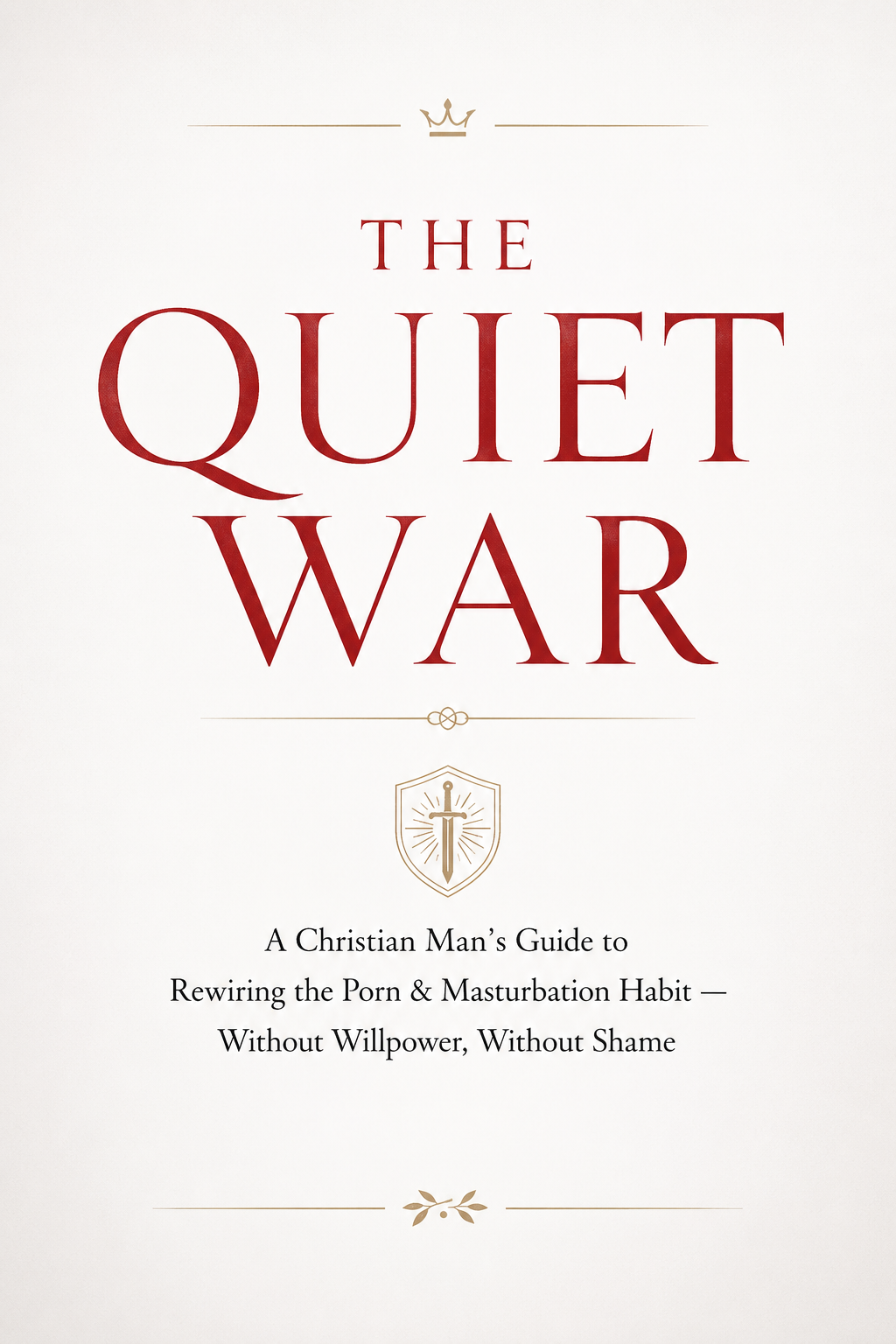
The Quiet War
A Christian Man's Guide to Rewiring the Porn & Masturbation Habit — Without Willpower, Without Shame
Inside this e-guide, you'll discover:
- The Trigger Map — a worksheet that shows you exactly where and when your urges are actually born, so you stop being ambushed by them.— Pg. 4
- The "First 60 Seconds" Script — the exact response to use in the sixty seconds after an urge hits, before it takes over.— Pg. 9
- The Journey Private Tracker — built to track your wins and your triggers, never your shame.— Pg. 14
- The Environment Reset Checklist — the quiet, practical changes that remove half the battle before it even starts.— Pg. 20
- The Slip Recovery One-Pager — what to do the moment you slip, so one bad night never turns into a lost month again.— Pg. 24
And the best part? You don't need another long fast, another accountability partner to avoid, or more "faith" you're told you're lacking. It's the same simple method that worked for me and that I've since walked through with other men in my own congregation and beyond, quietly, one conversation at a time.
A note on testimonials: This is a newly launched guide, so there are no buyer testimonials here yet — and we'd rather leave this section honest than invent ones. As real readers share their experience, their stories will replace the placeholders below.
— Reserved for a future reader testimonial —
— Reserved for a future reader testimonial —
Just So You Know...
Putting this guide together — properly, not rushed — cost me over ₦112,000. That went into:
- Research and structuring the method into a clear, step-by-step framework
- Editing and proofreading so every page reads clearly and privately, without confusion
- Design and layout of the worksheets and trackers
- Building and testing the Journey Tracker so it's actually usable, not just decorative
- Hosting and the checkout system so you can get it instantly and privately
₦112,000
₦56,000
₦28,000
In fact, you won't even pay the original price.
A fair price for this would be just ₦15,000.
₦15,000
₦9,000
This discounted price is only available to the first 50 buyers, after that, it goes back up.
A quick, honest note on the price: The ₦9,000 rate is genuinely limited to the first 50 people who get the guide. Once that group is reached, the price returns to ₦15,000 — there's no countdown clock, just a real early-access window while this guide is newly launched.
If you've read this far, this probably isn't a coincidence. Take the step while the door's still open at this price.
Still Feeling Unsure?
I totally understand. Which is why I'm making you a simple, risk-free promise:
Use The Quiet War for 30 days. Work through the Trigger Map, use the Journey Tracker honestly, apply the First 60 Seconds script when urges come. If you don't see real results, just reach out and you'll get a full refund — no interrogation, no guilt trip. This is meant to help you, not trap you.
Two Roads From Here
Option 1: Take action. Get The Quiet War. Start rewiring the pattern that's been quietly running your life — privately, at your own pace, starting tonight.
Option 2: Close this page and keep doing what hasn't worked. Maybe you were meant to see this today. Maybe not. Either way, the choice is yours.